

Strategist Jim Paulsen just said the perfect quote to be scoffed at on social media. Of course he doesn't believe this but it makes for the headline of the day for CNBC. Gotta love it. In the past, you would probably say that this signals a market top but if you look below the headline, his bullish case is much like ours. He just said the quote to gain more views and mission accomplished on that.

Long-term Jobs Killer Is Not China, It’s Automation
About five years ago, I was traveling on business to Los Angeles. I was surprised to find kiosks at Alamo that processed my reservation, assigned my rental car, and directed me to the spot for pick up. As I drove out, I marveled, “Wow, I was in and out of there without talking to single person!” Today, this once novel concept is quickly becoming common place.
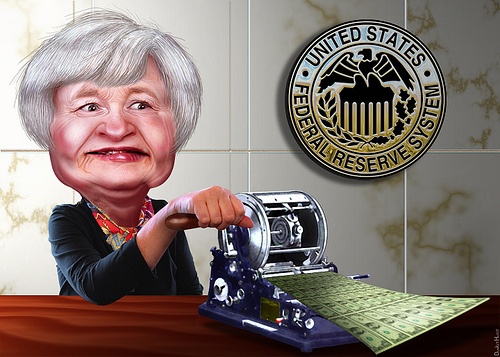
3 Reasons Why the Fed Won’t Raise Rates and Is More Likely to Ease
Back in March 2015, we wrote that you shouldn't count on the Fed to raise rates in 2015 because of deflation and slowing growth. In September, we wrote that recession is just around the corner in the US.
Therefore (unlike the street), we were not surprised by Friday's weak job report where job growth was less than expected. Not only that, wages disappointed, revisions to August's report were bad, and the participation rate fell to a new 38-year-low.
It's time for investors to stop listening to the media noise and if you look at the the actual data, you can only reach one conclusion: the Fed will not raise rates in 2015 or 2016, but they will soon turn 180 degrees and start talking about the next round of QE (quantitative easing) and/or negative rates.
Let's take a look at 3 reasons why the data dependent Fed can't raise rates anytime soon.

Black Swan Watch: The Oil Bubble Bursts
Major bear markets are typically caused by sharply rising interest rates, declines in corporate profits, gross overvaluation and severe recessions. The Runnymede team is always diligently and systematically monitoring the standings of these critical variables.
The most challenging factors which we spend time thinking about and analyzing are “”Black Swan”” events. These rare and unpredictable events cause severe damage because of psychological biases that make people individually and collectively blind. One potential black swan in our sights is the US shale oil bubble bursting. This has appeared on our radar screens because of the crude oil crash over the last half year which has seen prices of crude oil fall from $107/barrel to just $46/barrel today. Needless to say, this is a large deviation which has laid witness to a 57% decline in the price of oil. So what are the possible implications for the US economy and the stock market?
Graph of Every Job in America Shows Service Sector Dominates
The June non-farm payrolls report from the Bureau of Labor Statistics indicated that 288,000 non-farm payroll jobs were added during June – beating economists’ expectations of an increase by 211,000 jobs. The unemployment rate dropped from 6.3 percent to 6.1 percent.
According to the national employment report compiled by payroll processor Automatic Data Processing, the U.S. private sector added 281,000 new jobs last month, the fastest pace since late 2012. Of the new jobs added in June, 82% were service-sector, 5% were factory-sector, and 13% were construction.
U.S. Jobs: It’s All About The Service Sector
The U.S. Service Sector is not only the economy's most diverse sector, it is huge – employing 90% of the workforce. Service workers are the highest paid and best educated, and they are the lowest paid and least educated. The sector encompasses neurosurgeons, college professors, delivery-truck drivers and dishwashers.
The United States Census Bureau published an interesting study entitled “1940-2010: How Has America Changed?” Looking at the American workforce, we see that it has more than tripled in the last 70 years with a major industry shift from jobs in manufacturing and agriculture (41.9%) to service jobs. This mega trend is unlikely to reverse any time soon.