
central banks

How low can you go? Bond yields are going negative!

Negative interest rates are a fascinating topic for professional economists as well as the investing public. Using conventional wisdom, one would think that interest rates earned on investments are never less than zero because investors could just stuff their money under their mattresses for free.

Why would anyone want to pay for the privilege of owing a government bond? Generally nominal rates are positive but negative rates come at times of extreme fear, uncertainty and turmoil, with investors fleeing risk assets to perceived safer assets. We saw this in 2008 when Treasury bill auctions tipped into negative yields. The Treasury market saw this again several times in the weak recovery and as recently as September 2014 with T-bills dropping slightly into the red.
Read More

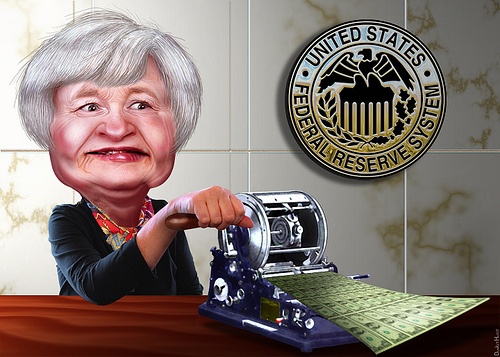
Follow the Loser: The Abnormal Behavior of Central Bankers

In sports, business or most avenues of life, people are encouraged to learn, imitate or follow the winners. In golf, we want to learn from Rory Mcllroy, Adam Scott or Phil Mickelson. In tennis, we want to emulate Novak Djokovic, Roger Federer or Rafael Nadal. To this motivational wisdom of following the winners, there is one exception, however. Central bankers seem to like to follow the loser.

Quantitative Easing (“QE”), creating money to buy bonds issued by the government, was first used by the Bank of Japan in the early part of the 2000’s. Japan was once known as the land of technological and engineering marvels, but more recently it has become known as one of the worst-managed economies in the world. The lost decades of the 1990’s/2000’s have extended into the 21st century, with subpar economic growth, Fukushima radiation out of control and a declining population amongst the list of negative trends.

Read More

The Winners and Losers of Falling Oil Prices

Since June, oil has been on a sharp decline from $107/barrel to $67/barrel. Thanks to slowing global growth and OPECs reluctance to cut supply, oil prices have fallen to their lowest levels since 2009. As a consumer it is wonderful to see gas prices around $2.50 again. It's been a long time coming. You often read that consumer stocks are the big beneficiaries of falling oil prices but is this truly the case? Let's take a quick look at the potential winners and losers of falling oil prices…

Read More

The bond bull market is alive and kicking

2013 was a brutal year for bond bulls. After Ben Bernanke mentioned the word taper in May, bond investors rushed for the door. From June to December 2013, bond mutual funds saw staggering outflows of $176.8 billion. Pimco's flagship Total Return Fund posted a 1.9% decline, its first down year since 1999. That fund saw its assets shrink by over $41 billion in 2013. Many proclaimed that the bond bull market was over and left for dead.

Read More