

How is the economy doing currently? Not well. The United States has had two recessions in the 21st century, in 2001 and 2008/9. Our prognosis is that the US economy is losing steam quickly and the third recession is getting near. Let’s look at the cost of money, raw material and labor. Due to a lack of demand, all current indications are that interest rates, commodity prices and real wages will continue to fall.
Why the Fed won’t raise rates in 2015 in one simple chart
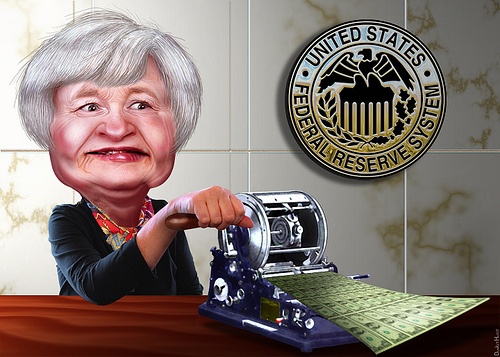
Today with bated breath, the financial markets are waiting on the FOMC statement for any hints of a potential rate hike in 2015. Many economists are still expecting a hike in September or October but at Runnymede, we remain highly skeptical that the Fed will raise rates in 2015. Like we have been saying since March, the data dependent Fed just doesn't have the numbers to justify their first rate hike. Janet Yellen and the Fed target 2% inflation and sorry we aren't anywhere near that number. She should be more worried about deflation than inflation at this point.
First Quarter 2015 in Review: International markets melt up
I'm not sure where the first three months of the year went, perhaps they are still buried in Boston's snow piles. Wherever the time disappeared to, the central bankers took center stage in the first quarter and their actions dominated financial markets. The European Central Bank joined the QE party to the tune of at least 1.1 trillion Euros to be spent over the next 18 months. The Bank of Japan continues their monetary experiment of Abenomics and there is increasing speculation that they will push the dial further on stimulus which could last for the next 3+ years. Meanwhile economists in the US speculate on when the Fed will make their first rate hike. We don't expect a rate hike anytime in 2015, and maybe not even in 2016, thanks to low levels of inflation and slowing GDP growth.
What does Irving Fisher’s Equation of Exchange tell us about 2015?
Irving Fisher, who was one of the well-known economists of the early 1900’s, came up with the “Equation of Exchange” concept. In its time, it became a landmark theory and today, many people still consider the equation to be one of the most important theories of economics.
That equation was MV=PT to explain the key relationships as to how these variables interact with each other and the economy. M is the money supply. V is the velocity of money. Essentially this says how quickly the money supply is turned over. P is the price level. T is the aggregate transactions. So MV = PT means that the total transactions at the current price level is equal to the total money stock multiplied by how often it is turned over.
Reacting to Exogenous Variables in Financial Weather Forecasting
Both commodities and stock markets are considered leading indicators in economic analysis and forecasting. In 2014, the prices of industrial commodities including copper, oil, gas, steel and coal declined sharply. On a currency adjusted basis, the stock markets of Germany, Japan, Brazil, Australia, United Kingdom, Russia and Austria also fell. In the United States, the Dow Jones Industrial Average started the year at 16,576, down 2.8% to 15,935 as of October 16th while the Russell 2000 small cap declined 6.6% and S&P was flat in the same time period. The markets were signaling a possible economic slowdown in the G7 countries.
Will Fear of Deflation Bring More Quantitative Easing?
In January 2012, the Fed outlined its 2 percent goal for inflation. But despite buying more than $4 trillion in bonds since 2008, inflation has remained stubbornly below that goal. Because of this I am beginning to wonder if the Fed will consider turning quantitative easing back on for another round of asset purchases in 2015.